Dhanak vs Khaddar vs Karandi: Which Winter Fabric?
How Pakistan's winter suit fabrics differ in warmth, weight and finish, which one suits office, family visits or a wedding, and what each costs.
Every November the same question comes up in family WhatsApp groups: is this year's suit going to be khaddar again, or something a bit nicer? The fabric names get used loosely in shops, and two suits that both say "winter collection" can feel completely different once they are stitched. Here is how the main ones actually compare when you wear them.
Khaddar: the warm workhorse
Khaddar is a thick, tightly woven cotton with a slightly rough, matte surface. It is the warmest of the everyday options and the one most people grew up wearing to school, college and work in December.
It is easy to live with. It hides creases well, survives repeated washing, and printed khaddar is usually the most affordable winter suit you can buy. The downside is weight. A khaddar shalwar kameez can feel heavy indoors with a gas heater running, and it rarely looks dressy, even when embroidered.
Best for: daily wear, offices without central heating, and the coldest weeks in Lahore, Islamabad and Peshawar.
Karandi: textured and a little more polished
Karandi has a visible, slightly coarse texture and a natural, matte look. It is generally lighter than khaddar, which makes it comfortable from late autumn into early spring rather than only in the coldest weeks.
Because the texture does a lot of the work, karandi looks good with very little decoration. A plain or lightly printed karandi suit reads as smarter than the same design in khaddar. It can feel scratchy on sensitive skin, so a soft lining in the shirt is worth asking your tailor about.
Best for: the in-between months, work wear that should look considered, and anyone who finds khaddar too heavy.
Dhanak: soft, warm, and made for embroidery
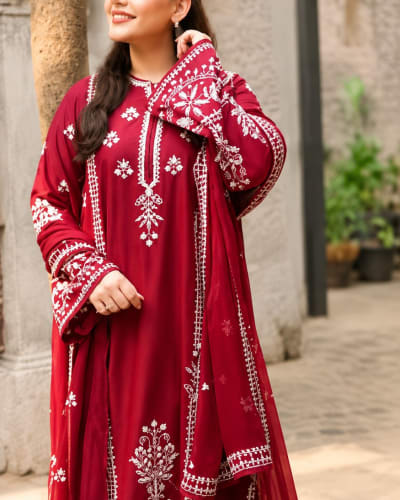
Dhanak is softer to the touch than both of the above, with a smooth surface and a comfortable drape. It is warm without being bulky, and it takes embroidery beautifully, which is why most embroidered winter three-piece suits are made in it.
This is the fabric to choose when the suit needs to do double duty: warm enough for a December evening, dressy enough for a dholki, a family dinner or a wedding you are attending as a guest rather than family. The softness also means it creases more easily than khaddar, so it needs a proper iron before going out.
Best for: visiting, family functions and wedding-season guest outfits.
Velvet and silk: for the big nights
Velvet is the most formal winter fabric and the warmest, but it is also heavy and expensive to stitch well. Most people own one velvet shawl or one velvet suit and save it for a barat or walima.
Silk is the opposite: light, with a sheen that photographs well, but not much warmth on its own. In winter it works for indoor functions, or under a heavy shawl.
Quick comparison
- Warmest: velvet, then khaddar.
- Softest: dhanak, then silk.
- Easiest to care for: khaddar.
- Best with embroidery: dhanak and velvet.
- Best for long months of wear: karandi, because it is comfortable across more of the season.
What winter suits cost right now
Most of the winter range on PakShop is embroidered dhanak, and prices fall into three rough bands:
- Under ₨4,000: simpler embroidered dhanak three-piece suits, from about ₨3,450, plus a two-piece embroidered silk suit at ₨3,999.
- ₨5,999 to ₨6,999: the bulk of the range. Fully embroidered shirts, embroidered sleeves, and often extra embroidered patches you can place on the neckline or sleeves.
- Around ₨7,500: pieces with a heavily embroidered dupatta as well as the shirt.
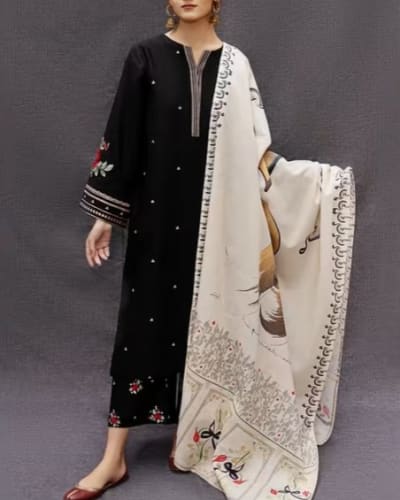
Look closely at what the third piece is. Some suits come with a regular dupatta, others with a big embroidered shawl. In January the shawl is worth a lot more than it looks in the photos, because it means you do not need a separate one on top.
How to choose
If you only buy one winter suit this year and you will wear it to work, buy khaddar or karandi. If you want one for weddings and visiting, buy embroidered dhanak, preferably with a shawl. And if your winters are mild, as in Karachi, skip the heaviest fabrics altogether. Dhanak or karandi will cover almost every occasion without leaving you too warm indoors.
Once you have picked your fabric, the full winter range is in unstitched fabric. Before handing a suit to your tailor, decide where each embroidered piece and patch should go, so nothing ends up on the back by mistake.